El debate de Yomil en la Universidad quedó empatado: 57 a 55, y la pregunta sigue sin respuestaThe Yomil debate at the University ended in a tie: 57 to 55, and the question remains unanswered
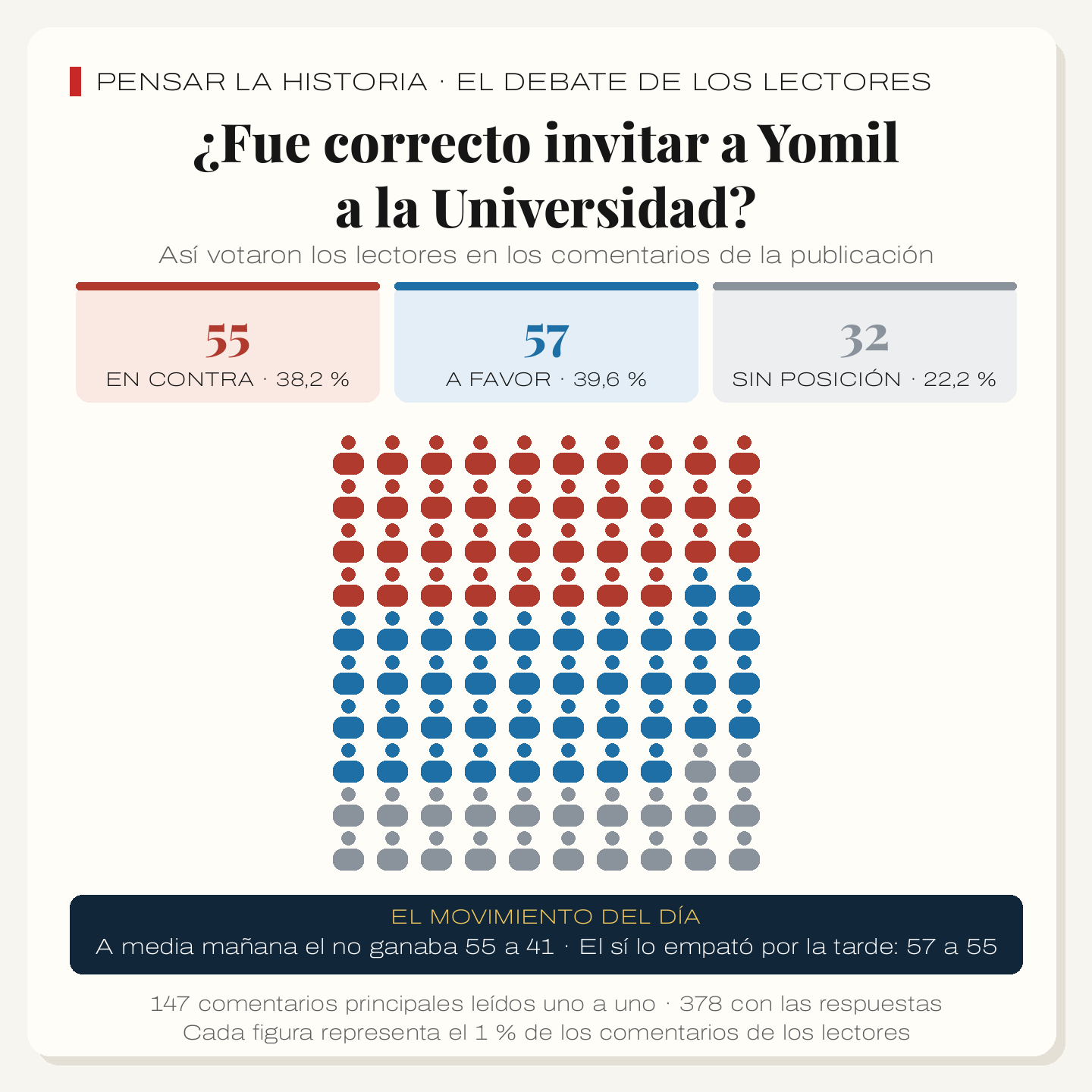
La pregunta era sencilla: ¿fue correcto invitar a Yomil a la Universidad de La Habana? La publicación de este domingo en Pensar la Historia suma 378 comentarios contando las respuestas, pasó de 100 mil vistas, y el debate siguió creciendo durante la noche, la mañana y la tarde. Para hacer el balance se leyeron uno a uno los 147 comentarios principales (sin contar los tres comentarios de impulso de esta casa). El resultado final del día: 57 comentarios a favor de la invitación (39,6 % del total de lectores), 55 en contra (38,2 %) y 32 que no tomaron posición (22,2 %). Entre los 112 que sí tomaron partido, un 50,9 % por el sí y un 49,1 % por el no. Empate técnico.
El movimiento del día es parte del balance. En el primer corte, a media mañana, el no ganaba con claridad: 55 a 41, un 57,3 % de los decididos. Después entraron 17 comentarios nuevos de lectores y el marcador se movió de un solo lado: 16 a favor, 1 sin posición y ninguno en contra. El bando contrario no sumó ni un comentario en ocho horas; el favorable lo alcanzó y lo pasó por dos. El debate estuvo partido todo el día, pero la foto final no es la de la mañana.
EL NO: «¿QUÉ APORTÓ?»
El argumento central de los que rechazan la invitación no fue el género musical. Fue la pertinencia. «¿Qué aportó en el debate?», preguntó Ppe Cuqui, y la misma pregunta, con otras palabras, apareció una y otra vez: qué puede enseñar sobre derechos fundamentales un artista sin formación jurídica, en una clase de Derecho Constitucional. «Con tantas personas preparadas en el tema, no es Yomil el que debía ser invitado», escribió Lebsoy Ainecalp. Otros propusieron nombres: Buena Fe, artistas de prestigio.
El segundo argumento del no fue político y pesó tanto como el primero: el papel de Yomil en los sucesos del 11 de julio de 2021 y su pedido público de restituir la Constitución de 1940. «Estamos hablando de alguien que está en contra del orden constitucional», escribió Rodrigo Huaimachi, en uno de los hilos más largos del bando contrario. «La Universidad es el templo de Félix Varela, no un plato de farándula», sentenció Aurora Rebelde, cuyo comentario reunió 9 respuestas. Para este bando, darle tribuna en una clase de Derecho Constitucional a quien cuestiona el orden constitucional es una contradicción, y la universidad debe mantenerse firme. También apareció la etiqueta de «colonización cultural» y la queja por el ejemplo que se ofrece a los estudiantes.
EL SÍ: SUMAR, DIALOGAR Y EL ESPEJO DE LA HISTORIA
Los defensores de la invitación se apoyaron en otra idea: la universidad es pública, es de todos, y su esencia es el debate. «Se trata de sumar y multiplicar, no de dividir y restar», escribió Aymee Hernandez. «Debemos aspirar a la unidad en el patriotismo cubano, a pesar de las diferencias, incluso las ideológicas», escribió Ana Teresa Badia, autora del comentario con más respuestas de toda la publicación, 19. «Disentir no es un crimen; la diferencia aporta, la unanimidad casi siempre es falsa», añadió Belkis Dominguez.
La oleada de la tarde trajo voces nuevas a este bando. Claudia de Cuba contó que en 1997, como estudiante y dirigente de la FEU en la Facultad de Biología, vivió debates con invitados muy distintos, y votó sí sin dudar. Ariel Estenoz, profesor de la UH durante años, escribió que la universidad debe abrirse al mundo y dejar de temer a cantantes, críticos y disidentes: si la razón está de un lado, ese lado prevalecerá.
Y se repitieron dos argumentos más. El histórico: «Si Jimmy Carter pudo hablar en el Aula Magna de la Universidad de La Habana defendiendo ideas que cuestionaban abiertamente el sistema político cubano, ¿por qué Yomil no puede tener también su espacio?», preguntó Alejandro Gargallo, y Lino Hernández Suárez lo resumió así: «Obama estuvo en La Habana y no pasó nada». Y el práctico, firmado por docentes: una profesora universitaria, Yudisney Brito Mayea, felicitó la iniciativa porque hablar en el código de los estudiantes es la manera de llegar a ellos, y Williams Garcia recordó que un artista con su trayectoria sí tiene algo concreto que aportar a una clase de Derecho: su experiencia en contratación de artistas y derechos de autor.
LA PREGUNTA QUE QUEDÓ SIN RESPUESTA
El tercer grupo, más de una quinta parte de los comentarios, no votó: preguntó. ¿Qué se dijo en la clase? ¿Qué dijeron los profesores y los alumnos? ¿A qué conclusión llegaron? «Creo que este debería ser el debate», escribió Doony Leon Jimenez. Es la pregunta que ordena todo lo demás, porque sin saber qué ocurrió dentro del aula, una parte del juicio se hace a ciegas. Hasta hoy, ni la Facultad de Derecho ni el propio Yomil han contado el contenido de la clase más allá de la nota inicial.
El balance deja una conclusión clara: la discusión nunca fue sobre reguetón. Fue sobre quién tiene derecho a sentarse en un aula universitaria, qué es la universidad y hasta dónde llega el diálogo entre cubanos que piensan distinto. Y esa discusión, a juzgar por los comentarios que siguen entrando, no ha terminado.
The question was simple: was it right to invite Yomil to the University of Havana? This Sunday's post on Pensar la Historia has reached 378 comments including replies, passed 100,000 views, and the debate kept growing through the night, the morning and the afternoon. To draw up the balance, all 147 top-level comments were read one by one (not counting this page's own three boost comments). The final result of the day: 57 comments in favor of the invitation (39.6% of readers), 55 against (38.2%) and 32 that took no position (22.2%). Among the 112 who did take a side, 50.9% said yes and 49.1% said no. A technical tie.
The movement of the day is part of the balance. In the first count, mid-morning, the no side was clearly ahead: 55 to 41, 57.3% of those who took a side. Then 17 new reader comments came in and the score moved on one side only: 16 in favor, 1 with no position and none against. The opposing side did not add a single comment in eight hours; the favorable side caught up and moved ahead by two. The debate was split all day, but the final picture is not the morning's.
THE NO: "WHAT DID HE CONTRIBUTE?"
The central argument of those who reject the invitation was not the musical genre. It was relevance. "What did he contribute to the debate?", asked Ppe Cuqui, and the same question, in other words, appeared again and again: what can an artist with no legal training teach about fundamental rights in a Constitutional Law class. "With so many people prepared on the subject, Yomil was not the one who should have been invited", wrote Lebsoy Ainecalp. Others proposed names: Buena Fe, prestigious artists.
The no side's second argument was political and weighed as much as the first: Yomil's role in the events of July 11, 2021 and his public call to restore the 1940 Constitution. "We are talking about someone who is against the constitutional order", wrote Rodrigo Huaimachi, in one of the longest threads on the opposing side. "The University is the temple of Félix Varela, not a show-business set", declared Aurora Rebelde, whose comment gathered 9 replies. For this side, giving a platform in a Constitutional Law class to someone who questions the constitutional order is a contradiction, and the university must stand firm. The label of "cultural colonization" also appeared, along with complaints about the example offered to students.
THE YES: ADDING UP, DIALOGUE AND THE MIRROR OF HISTORY
The defenders of the invitation rested on another idea: the university is public, it belongs to everyone, and its essence is debate. "It is about adding and multiplying, not dividing and subtracting", wrote Aymee Hernandez. "We must aspire to unity in Cuban patriotism, despite the differences, even ideological ones", wrote Ana Teresa Badia, author of the comment with the most replies in the whole post, 19. "Dissenting is not a crime; difference contributes, unanimity is almost always false", added Belkis Dominguez.
The afternoon wave brought new voices to this side. Claudia de Cuba recalled that in 1997, as a student and FEU leader at the Faculty of Biology, she lived through debates with very different guests, and voted yes without hesitation. Ariel Estenoz, a UH professor for years, wrote that the university must open itself to the world and stop fearing singers, critics and dissidents: if reason is on one side, that side will prevail.
And two more arguments were repeated. The historical one: "If Jimmy Carter could speak at the University of Havana's Aula Magna defending ideas that openly questioned the Cuban political system, why can't Yomil have his space too?", asked Alejandro Gargallo, and Lino Hernández Suárez summed it up this way: "Obama was in Havana and nothing happened". And the practical one, signed by teachers: a university professor, Yudisney Brito Mayea, praised the initiative because speaking in the students' code is the way to reach them, and Williams Garcia recalled that an artist with his career does have something concrete to contribute to a Law class: his experience in artist contracting and copyright.
THE QUESTION LEFT UNANSWERED
The third group, more than a fifth of the comments, did not vote: it asked. What was said in the class? What did the professors and students say? What conclusion did they reach? "I think this should be the debate", wrote Doony Leon Jimenez. It is the question that orders everything else, because without knowing what happened inside the classroom, part of the judgment is made blindly. To this day, neither the Faculty of Law nor Yomil himself has recounted the content of the class beyond the initial note.
The balance leaves one clear conclusion: the discussion was never about reggaeton. It was about who has the right to sit in a university classroom, what the university is, and how far dialogue reaches among Cubans who think differently. And that discussion, judging by the comments still coming in, is not over.