Qué dijo y qué no dijo Carlos Saladrigas a La Joven CubaWhat Carlos Saladrigas Said — and Didn't Say — to La Joven Cuba
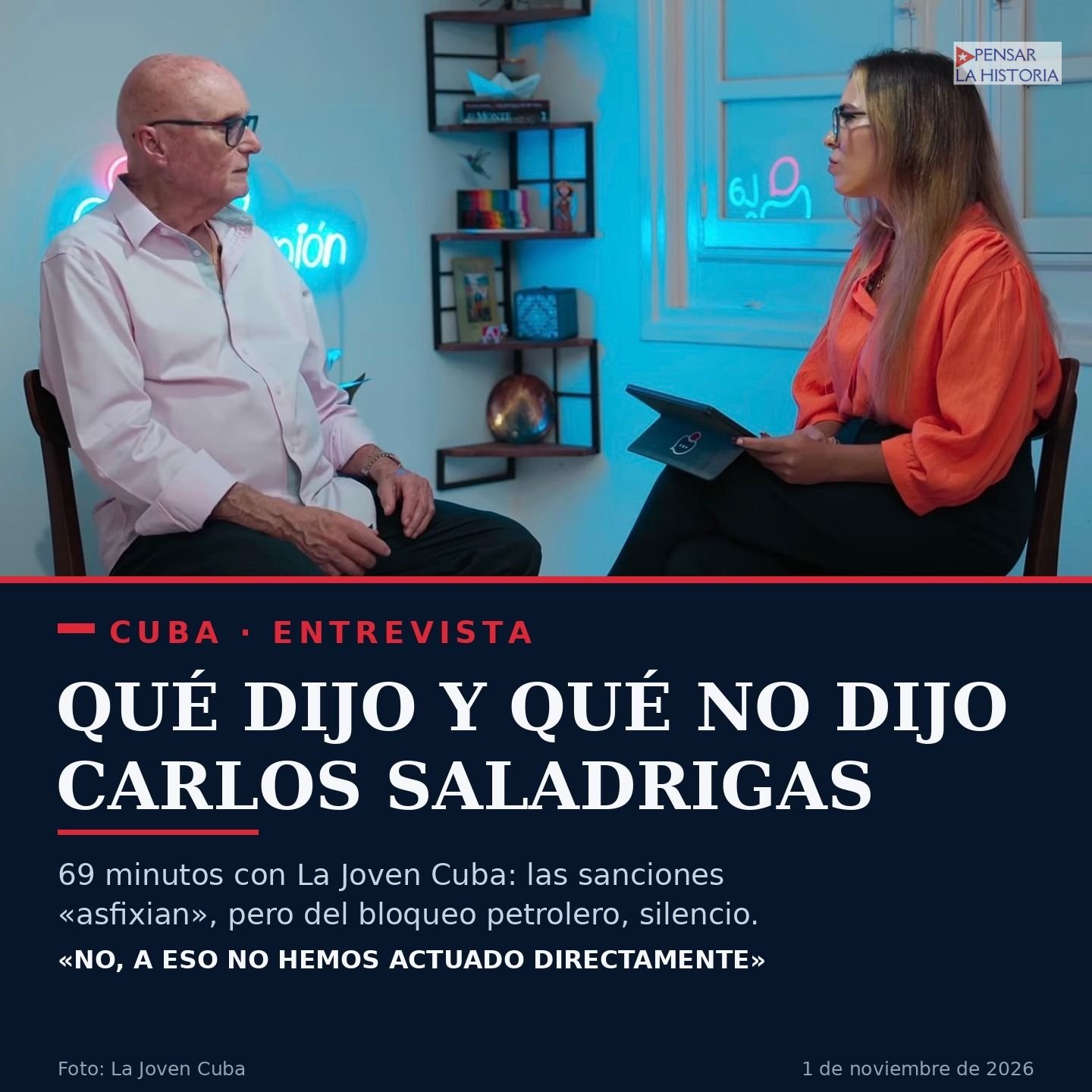
⚠️ QUÉ DIJO Y QUÉ NO DIJO CARLOS SALADRIGAS A LA JOVEN CUBA
Ayer, sábado 31 de octubre, La Joven Cuba publicó en su pódcast «La
Reunión — A lo cortico» una conversación de 69 minutos con Carlos
Saladrigas, el empresario cubanoamericano presidente del Cuba Study
Group, entrevistado por Mariana Camejo. Vale la pena escucharla entera.
Y vale la pena medir no solo lo que dijo, sino también lo que no dijo.
1️⃣ LO QUE SÍ DIJO, Y CON FUERZA: «Las sanciones norteamericanas son
extremadamente onerosas, al punto de que asfixian cualquier crecimiento
económico que haya... eso requiere a todas que se alivien o se eliminen
las sanciones, aunque sea de forma gradual». Dijo que las sanciones «van
a la arteria yugular de la economía: van a la inversión, van a las
transferencias bancarias, van al financiamiento». Que sin mejorar las
relaciones con Estados Unidos no hay recuperación posible. Que una
operación militar haría «un daño irreparable al sentido de nación y de
la soberanía nacional de Cuba». Que la salud y la educación gratuitas
son «los dos logros más importantes de la revolución» y defenderlas,
«una decisión soberana perfectamente legítima». Y una frase para
guardar: «Tenemos que dejar de pensar en Cuba como un conflicto por
ganar y empezar a ver a Cuba como un problema por resolver».
2️⃣ LO QUE DIJO A MEDIAS: Que si el deshielo de Obama fracasó fue
porque «Cuba no correspondió... se han desperdiciado 15 años, 16 años».
Que la política de presión — en palabras de diplomáticos europeos que él
repite — «es la única forma en que Cuba reacciona», aunque «no quiere
decir que yo la apoye». Que su vieja frase del «tutelaje» fue un
problema de traducción: él pensaba en un tutor que ayuda en una
asignatura... para defender a continuación que la economía cubana debe
integrarse financieramente a la de Estados Unidos, con «los mismos
esquemas bancarios» y «el mismo idioma comercial». Y sobre quién debe
moverse primero: «Vamos a decir que el más chiquito venga primero,
presente un cambio significativo, y entonces hay que decir: bueno,
Estados Unidos, ¿cómo tú ahora vas a actuar? Ya Cuba cambió».
3️⃣ LO QUE NO DIJO — Y AQUÍ ESTÁN LOS MINUTOS: Mariana le preguntó
directamente, en el minuto 48, si el Cuba Study Group tiene alguna
posición pública sobre el incremento de las sanciones y sobre EL
BLOQUEO PETROLERO. Su respuesta: «No, a eso no hemos actuado
directamente». Y añadió que «al principio estuvimos silentes sobre el
embargo». En 69 minutos de entrevista no mencionó UNA SOLA VEZ a
Venezuela — el origen del corte petrolero que él mismo diagnostica como
asfixia — ni la orden ejecutiva arancelaria de enero. Ni una vez
aparecen «presos políticos», «elecciones», «Díaz-Canel», «Partido
Comunista» o «GAESA». La palabra «democracia» no se pronuncia en toda
la entrevista. Preguntado sobre a quién benefician hoy las sanciones
contra el sector privado cubano, no nombró a nadie. Y la justicia y la
memoria histórica, para él, pueden esperar: los crímenes y las
violaciones de derechos humanos «en ambas orillas» van, en sus
palabras, «en el cabús, en el último vehículo del tren».
⭐ EL CONTRASTE: en 2021, Saladrigas decía que el primer paso lo tenía
que dar Washington, eliminando las políticas de Trump que «solo le hacen
daño al pueblo cubano». Ayer, el primer paso lo tiene que dar La Habana:
bajo presión, primero «el más chiquito».
Su diagnóstico es el nuestro: las sanciones asfixian a Cuba. Su receta
y sus silencios, no: aceptar la presión como palanca y que su
organización no haya dicho ni una palabra pública frente al bloqueo
petrolero.
💬 Pregunta seria para los que lo escucharon: ¿se puede estar contra
las sanciones y al mismo tiempo guardar silencio ante el bloqueo
petrolero? ¿Qué les pareció lo que dijo... y lo que no dijo? Los leo. 👇
📌 Fuente: «A lo cortico, con Carlos Saladrigas», La Joven Cuba
(YouTube, 31 de octubre de 2026). Las citas son textuales, de la
transcripción de la entrevista.
#Cuba #LaJovenCuba #Bloqueo #PensarLaHistoria
⚠️ WHAT CARLOS SALADRIGAS SAID AND DID NOT SAY TO LA JOVEN CUBA
Yesterday, Saturday, October 31, La Joven Cuba published on its podcast "La Reunión — A lo cortico" a 69-minute conversation with Carlos Saladrigas, the Cuban American businessman, president of the Cuba Study Group, interviewed by Mariana Camejo. It is worth listening to it in its entirety. And it is worth measuring not only what he said, but also what he did not say.
1️⃣ WHAT HE DID SAY, AND WITH FORCE: "U.S. sanctions are extremely onerous, to the point that they suffocate any economic growth there may be... that requires, above all, that the sanctions be relieved or eliminated, even if gradually." He said that the sanctions "go to the jugular artery of the economy: they go to investment, they go to bank transfers, they go to financing." That without improving relations with the United States there is no possible recovery. That a military operation would do "irreparable damage to the sense of nation and to the national sovereignty of Cuba." That free health care and education are "the two most important achievements of the revolution" and that defending them is "a perfectly legitimate sovereign decision." And a phrase worth keeping: "We have to stop thinking of Cuba as a conflict to be won and start seeing Cuba as a problem to be solved."
2️⃣ WHAT HE ONLY HALF SAID: That if Obama's thaw failed it was because "Cuba did not reciprocate... 15 years, 16 years have been wasted." That the policy of pressure — in the words of European diplomats, which he repeats — "is the only way Cuba reacts," although "that does not mean I support it." That his old "tutelaje" phrase was a problem of translation: he was thinking of a tutor who helps you in a subject... only to then defend that the Cuban economy must integrate itself financially with that of the United States, with "the same banking frameworks" and "the same commercial language." And on who must move first: "Let's say that the littlest one comes first, presents a significant change, and then it has to be said: well, United States, how are you going to act now? Cuba has already changed."
3️⃣ WHAT HE DID NOT SAY — AND HERE ARE THE MINUTES: Mariana asked him directly, at minute 48, whether the Cuba Study Group has any public position on the increase of the sanctions and on THE OIL BLOCKADE. His answer: "No, on that we have not acted directly." And he added that "at the beginning we remained silent about the embargo." In 69 minutes of interview he did not mention Venezuela A SINGLE TIME — the origin of the oil cutoff that he himself diagnoses as asphyxiation — nor the tariff executive order of January. Not once do "political prisoners," "elections," "Díaz-Canel," "Communist Party," or "GAESA" appear. The word "democracy" is not uttered in the entire interview. Asked whom today's sanctions against the Cuban private sector benefit, he named no one. And justice and historical memory, for him, can wait: the crimes and the human rights violations "on both shores" go, in his words, "in the caboose, in the last car of the train."
⭐ THE CONTRAST: in 2021, Saladrigas said that the first step had to be taken by Washington, eliminating Trump's policies that "only do harm to the Cuban people." Yesterday, the first step has to be taken by Havana: under pressure, the littlest one first.
His diagnosis is ours: the sanctions asphyxiate Cuba. His recipe and his silences are not: to accept pressure as leverage, and that his organization has not said a single public word in the face of the oil blockade.
💬 A serious question for those who listened to him: can one be against the sanctions and at the same time remain silent in the face of the oil blockade? What did you think of what he said... and of what he did not say? I read your comments. 👇
📌 Source: "A lo cortico, con Carlos Saladrigas," La Joven Cuba (YouTube, October 31, 2026). The quotations are verbatim, from the transcript of the interview.
#Cuba #LaJovenCuba #Bloqueo #PensarLaHistoria
Ver en Facebook ↗See on Facebook ↗