LEY 186: CUBA REDISEÑA SU GOBIERNOLAW 186: CUBA REDESIGNS ITS GOVERNMENT
LEY 186: CUBA REDISEÑA SU GOBIERNO
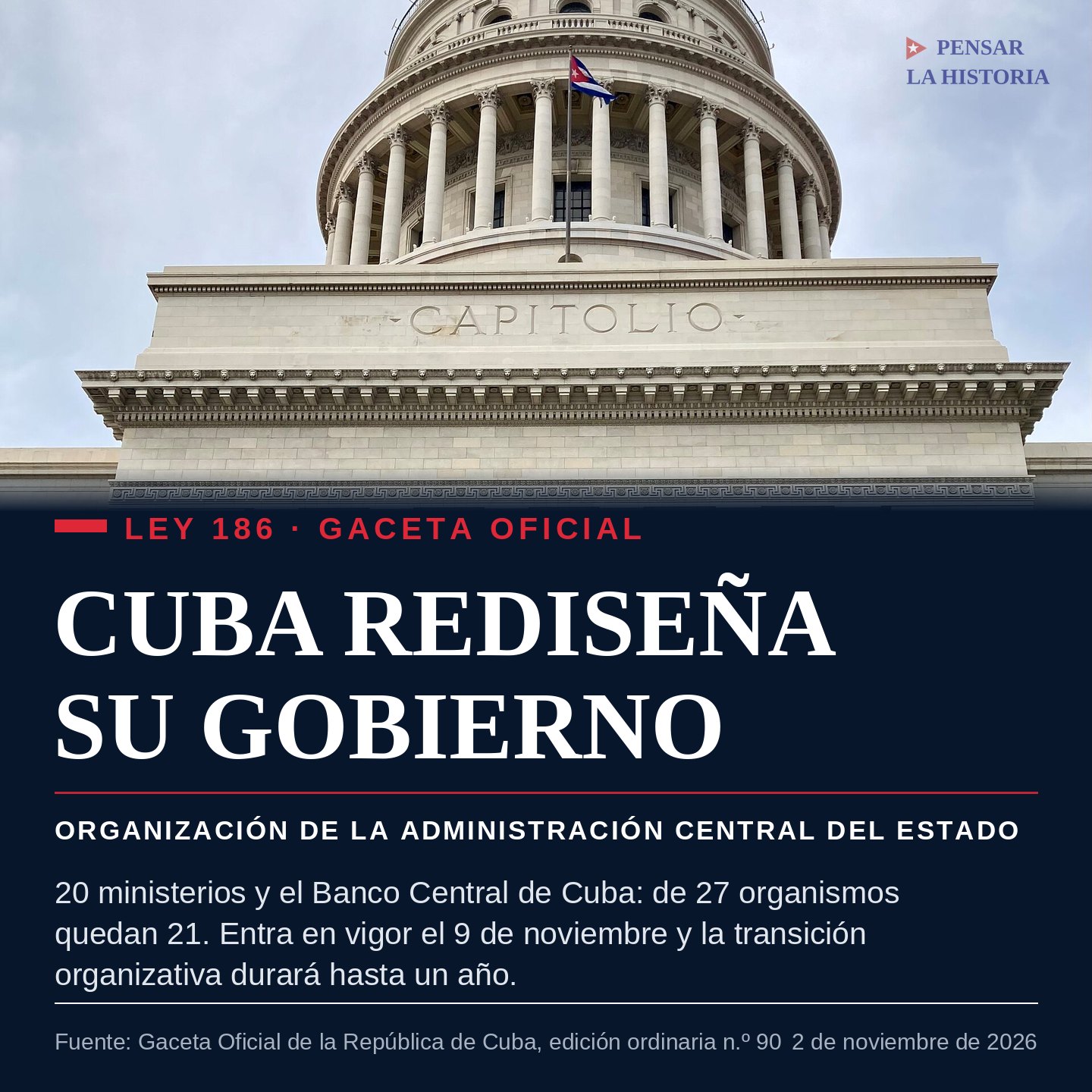
La Gaceta Oficial de la República de Cuba, en su edición ordinaria número 90, correspondiente a este 2 de noviembre de 2026, publicó la Ley 186 «De Organización de la Administración Central del Estado». La Asamblea Nacional del Poder Popular la había aprobado el 30 de julio, pero es la publicación la que permite conocer su texto definitivo y la que pone a correr el plazo de su entrada en vigor.
La norma cumple el mandato del artículo 146 de la Constitución, que reserva a una ley la composición y las funciones de la Administración Central del Estado. Es, en la práctica, el rediseño más profundo del aparato de Gobierno cubano en años.
DE 27 A 21 ORGANISMOS
La Administración Central queda integrada por 20 ministerios y el Banco Central de Cuba, que mantiene su condición de organismo de la Administración Central, dirigido por un ministro-presidente, sin clasificarse como ministerio. La reorganización reduce de 27 a 21 los organismos centrales: varias carteras desaparecen como entes independientes y sus funciones pasan a organismos más amplios.
LAS GRANDES FUSIONES
· Ministerio de Agricultura y Alimentación. Bajo un solo mando quedan la producción agropecuaria, cañera y forestal, la industria alimentaria, el azúcar y sus derivados y la actividad pesquera. Es la fusión que más directamente toca la mesa del cubano.
· Ministerio de Economía y Finanzas. Unifica las funciones de Economía y Planificación y de Finanzas y Precios: planificación, presupuesto del Estado, política tributaria y precios bajo un mismo techo.
· Ministerio de Educación Superior, Ciencia e Innovación. Reúne la educación superior con la ciencia y la innovación.
· Ministerio de Medio Ambiente, Hábitat y Recursos Hidráulicos. Suma a la política ambiental y climática el ordenamiento territorial, el urbanismo, el catastro, la vivienda y la gestión del agua, incluido el control del patrimonio hidráulico.
· Ministerio de Industrias y la Construcción. Agrupa la industria y la construcción.
· Ministerio de Comercio e Inversión Extranjera. Reúne en una sola cartera el comercio y la inversión extranjera.
Se mantienen, entre otros, los ministerios de Relaciones Exteriores, Salud Pública, Educación, Cultura, Energía y Minas, Transporte, Turismo, Justicia, Trabajo y Seguridad Social, Comunicaciones, Información y Comunicación Social, Deportes y Recreación, el Interior y las Fuerzas Armadas Revolucionarias.
EL RELOJ DE LA TRANSICIÓN
La disposición final décima fija la entrada en vigor a los siete días de la publicación: el lunes 9 de noviembre de 2026. Entrar en vigor no significa que el rediseño se complete ese día: las disposiciones transitorias conceden hasta un año, desde la entrada en vigor, para realizar los movimientos organizativos y traspasar los recursos humanos, materiales y financieros a los organismos que asuman cada función. Los ministros y el ministro-presidente del Banco Central deberán presentar sus cronogramas de trabajo dentro de los 30 días naturales siguientes al 9 de noviembre.
LO QUE LA LEY NO HACE
La Ley 186 regula estructura y competencias. Por sí sola no establece aumentos salariales, ni nuevas tarifas de servicios, ni modificaciones en la libreta de abastecimiento, ni requisitos adicionales para los trámites de la población. Tampoco anuncia el cierre inmediato de oficinas ni dependencias territoriales: fija la estructura central y habilita la reorganización que vendrá después.
LA PREGUNTA DE FONDO
Queda por ver si el nuevo organigrama se traduce en un Estado que responda mejor donde más duele: los alimentos, la vivienda, el agua y los precios. La estructura es el mapa; el resultado se medirá en la vida diaria. Pensar la Historia seguirá el proceso paso a paso, cronograma en mano.
Fuentes: Gaceta Oficial de la República de Cuba, edición ordinaria n.º 90 (2 de noviembre de 2026); Granma (2 de noviembre de 2026).
LAW 186: CUBA REDESIGNS ITS GOVERNMENT
The Official Gazette of the Republic of Cuba, in its ordinary edition No. 90, dated November 2, 2026, published Law 186, "On the Organization of the Central State Administration." The National Assembly of People's Power had approved it on July 30, but it is publication that makes its final text known and starts the clock on its entry into force.
The law fulfills the mandate of Article 146 of the Constitution, which reserves to a law the composition and functions of the Central State Administration. In practice, it is the deepest redesign of Cuba's government apparatus in years.
FROM 27 BODIES TO 21
The Central Administration will consist of 20 ministries plus the Central Bank of Cuba, which keeps its status as a Central Administration body, headed by a minister-president, without being classified as a ministry. The reorganization cuts the number of central bodies from 27 to 21: several portfolios disappear as independent entities and their functions pass to broader agencies.
THE GREAT MERGERS
· Ministry of Agriculture and Food. Under a single command: agricultural, sugarcane and forestry production, the food industry, sugar and its derivatives, and fishing. It is the merger that most directly touches the Cuban table.
· Ministry of Economy and Finance. It unifies the functions of Economy and Planning and of Finance and Prices: planning, the state budget, tax policy and prices under one roof.
· Ministry of Higher Education, Science and Innovation. It brings higher education together with science and innovation.
· Ministry of Environment, Habitat and Hydraulic Resources. It adds territorial planning, urban planning, the cadaster, housing and water management — including control of hydraulic assets — to environmental and climate policy.
· Ministry of Industries and Construction. It groups industry and construction.
· Ministry of Trade and Foreign Investment. It brings trade and foreign investment together in a single portfolio.
Among those that remain are the ministries of Foreign Affairs, Public Health, Education, Culture, Energy and Mines, Transportation, Tourism, Justice, Labor and Social Security, Communications, Information and Social Communication, Sports and Recreation, the Interior, and the Revolutionary Armed Forces.
THE TRANSITION CLOCK
The tenth final provision sets entry into force seven days after publication: Monday, November 9, 2026. Entry into force does not mean the redesign is completed that day: the transitory provisions allow up to one year, from entry into force, to carry out the organizational moves and transfer the human, material and financial resources to the bodies assuming each function. The ministers and the minister-president of the Central Bank must present their work schedules within the 30 calendar days following November 9.
WHAT THE LAW DOES NOT DO
Law 186 regulates structure and powers. By itself it establishes no salary increases, no new service rates, no changes to the ration book, and no additional requirements for the public's paperwork. Nor does it announce the immediate closure of offices or territorial branches: it fixes the central structure and enables the reorganization that will follow.
THE QUESTION THAT MATTERS
It remains to be seen whether the new organizational chart translates into a state that responds better where it hurts most: food, housing, water and prices. The structure is the map; the result will be measured in daily life. Pensar la Historia will follow the process step by step, schedule in hand.
Sources: Official Gazette of the Republic of Cuba, ordinary edition No. 90 (November 2, 2026); Granma (November 2, 2026).
Ver en Facebook ↗See on Facebook ↗