España a ocho días de las urnas: tras el debate, el PSOE recorta a siete décimas y PP y Vox suman 189 escañosSpain eight days from the polls: after the debate, the PSOE cuts the gap to seven tenths and PP and Vox total 189 seats
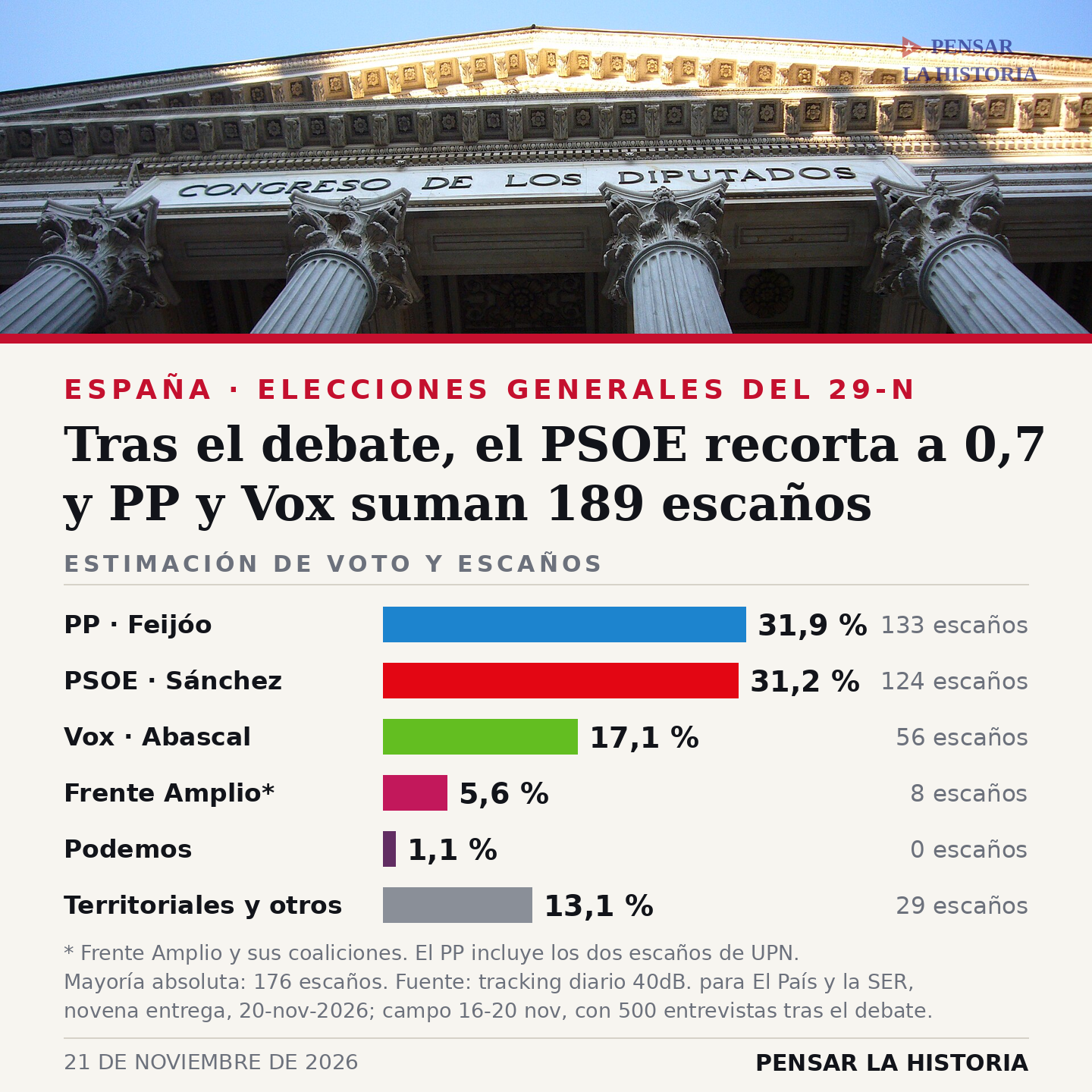
A ocho días de las elecciones generales del domingo 29 de noviembre, ya se puede medir el primer efecto del debate, y el resultado es una paradoja. La novena entrega del tracking diario de 40dB. para El País y la Cadena SER, publicada este viernes 20 de noviembre, es la primera que incorpora entrevistas realizadas después del cara a cara entre Pedro Sánchez y Alberto Núñez Feijóo: 500 de sus 2.000 entrevistas se hicieron el propio viernes, con el debate ya celebrado. El PP sigue primero con el 31,9 % del voto y 133 escaños, contados los dos de su coalición con UPN. El PSOE sube un punto entero, hasta el 31,2 %, y alcanza 124 escaños. Vox cede medio punto, baja al 17,1 % y se queda en 56 diputados.
Sumados, PP y Vox alcanzan 189 escaños, tres menos que en la entrega anterior y trece por encima de la mayoría absoluta de 176. La ventaja del PP sobre el PSOE se estrecha a siete décimas, la mínima de toda la campaña, y el PSOE logra su mejor resultado desde las elecciones de 2023. La suma de los partidos que apoyaron la investidura de Sánchez en 2023 sube a 160 escaños, todavía a 16 de la mayoría. El margen de error del sondeo es de más o menos 2,2 puntos, con entrevistas realizadas entre el 16 y el 20 de noviembre en toda España, excepto Ceuta y Melilla.
El resto del mapa lo completan Frente Amplio, con el 3,8 % y 5 escaños; las demás coaliciones de izquierda, con el 1,8 % y 3; Podemos, con el 1,1 % y fuera del Congreso; y los partidos territoriales, que suman 29 diputados: Esquerra Republicana 10, Bildu 7, Junts 3, PNV 3, Adelante Andalucía 3, BNG 2 y Coalición Canaria 1. A la izquierda del PSOE, la suma se queda en 8 escaños, su peor marca desde que empezó la campaña.
GANÓ EL DEBATE Y PERDIÓ TERRENO
Según el propio sondeo de 40dB., el 43 % de los ciudadanos considera que Feijóo ganó el cara a cara del jueves, frente al 33,3 % que señala a Sánchez y un 16,4 % que no da la victoria a ninguno. El 76,3 % de los encuestados asegura que vio el debate, veinte puntos más que en el cara a cara de 2023. Y sin embargo, el movimiento en intención de voto favorece al perdedor del debate: el PSOE gana un punto y el PP pierde tres décimas. La SER apunta una explicación: a los indecisos que quedaban antes del debate, en torno al 7 %, no les convenció ninguno de los dos, y los socialistas han reducido la transferencia de su voto hacia PP y Vox, que hace una semana superaba los 12 puntos y ahora ronda los 8.
Hay además dos datos que conviven en tensión. El primero: preguntados por su preferencia para presidente del Gobierno, los españoles siguen eligiendo a Sánchez, con el 32,5 %, por delante de Feijóo, con el 23,1 %, y de Santiago Abascal, con el 16,7 %. El segundo: la participación promete ser muy alta, con un 69,4 % de electores que asegura que irá a votar seguro, nueve puntos más que a estas alturas de las elecciones de 2023, cuando la participación final fue del 66,6 %.
DOS FOTOS OPUESTAS DEL MISMO PAÍS
El tracking de 40dB. no es la única medición con trabajo de campo posterior al debate, y las demás no cuentan lo mismo. Data10, para OKDiario, con 3.000 entrevistas realizadas entre el 17 y el 20 de noviembre, sitúa al PP en el 32,3 % y 135 escaños, hunde al PSOE en el 26,6 % y 108 y deja a Vox en el 19,0 % y 63, con una suma de la derecha de 198 diputados. Sondaxe, para La Voz de Galicia, en su entrega de este sábado, da al PP el 29,5 % y 125 escaños, al PSOE el 27,9 % y 110 y a Vox el 19,8 % y 70, para un total de 195 entre populares y Vox. Sigma Dos, con campo hasta el jueves 19, deja al PP en el 31,2 %, al PSOE en el 27,6 % y a Vox en el 18,9 %. Y SW Demoscopia es la única firma que coloca primero al PSOE, con el 32,1 % frente al 29,6 % del PP.
La media que elabora Demócrata con la última medición de 19 institutos, en su corte de la mañana de este sábado 21, ordena el ruido: PP 31,0 %, PSOE 27,8 % y Vox 18,9 %, que cae por primera vez en la serie por debajo del 19 %. En escaños, con 16 proyecciones completas, la media da 130 al PP, 112 al PSOE y 64 a Vox, para una suma de 194 entre PP y Vox. Es decir, el avance del PSOE en 40dB. se diluye en el conjunto, pero la dirección de fondo se mantiene en todas las medias: la derecha conserva la mayoría y la disputa real está en su tamaño.
LA ENCUESTA QUE SIGUE DICIENDO LO CONTRARIO
Frente a todas las encuestadoras privadas sigue plantado el CIS oficial. Su barómetro preelectoral, publicado el 12 de noviembre con 45.074 entrevistas, pone primero al PSOE con el 33,3 % y entre 134 y 143 escaños, y relega al PP al 25,5 % y entre 98 y 106. Con esos números, PP y Vox sumarían entre 155 y 171 diputados, sin mayoría absoluta. No ha publicado actualización nueva.
Quedan ocho días y una sola ventana de medición: desde el martes 24 rige la veda y no podrán publicarse sondeos nuevos, así que los últimos llegarán el lunes 23. El domingo 29, España decide si confirma la mayoría de la derecha que dibujan casi todas las encuestas, si el recorte del PSOE tras el debate era el inicio de una remontada o si el CIS, contra todo el sector privado, era el que tenía razón.
Eight days before the general election on Sunday, November 29, the first effect of the debate can already be measured, and the result is a paradox. The ninth release of the daily 40dB. tracking poll for El País and Cadena SER, published this Friday, November 20, is the first to include interviews conducted after the head-to-head between Pedro Sánchez and Alberto Núñez Feijóo: 500 of its 2,000 interviews were carried out on Friday itself, with the debate already held. The PP remains first with 31.9% of the vote and 133 seats, counting the two from its coalition with UPN. The PSOE rises a full point, to 31.2%, and reaches 124 seats. Vox gives up half a point, drops to 17.1% and is left with 56 deputies.
Combined, PP and Vox reach 189 seats, three fewer than in the previous release and thirteen above the absolute majority of 176. The PP's lead over the PSOE narrows to seven tenths, the smallest of the whole campaign, and the PSOE achieves its best result since the 2023 election. The parties that backed Sánchez's investiture in 2023 total 160 seats, still 16 short of a majority. The poll's margin of error is plus or minus 2.2 points, with interviews conducted between November 16 and 20 across Spain, except Ceuta and Melilla.
The rest of the map is completed by Frente Amplio, with 3.8% and 5 seats; the other left-wing coalitions, with 1.8% and 3; Podemos, with 1.1% and out of Congress; and the regional parties, which total 29 deputies: Esquerra Republicana 10, Bildu 7, Junts 3, PNV 3, Adelante Andalucía 3, BNG 2 and Coalición Canaria 1. To the left of the PSOE, the combined total is just 8 seats, its worst mark since the campaign began.
HE WON THE DEBATE AND LOST GROUND
According to the 40dB. poll itself, 43% of citizens believe Feijóo won Thursday's head-to-head, against 33.3% who name Sánchez and 16.4% who give the victory to neither. 76.3% of respondents say they watched the debate, twenty points more than in the 2023 head-to-head. And yet the movement in voting intention favors the debate's loser: the PSOE gains a point and the PP loses three tenths. SER offers an explanation: the undecided voters who remained before the debate, around 7%, were convinced by neither of the two, and the Socialists have reduced the transfer of their vote toward PP and Vox, which a week ago exceeded 12 points and now hovers around 8.
There are also two figures that coexist in tension. The first: asked about their preference for prime minister, Spaniards still choose Sánchez, with 32.5%, ahead of Feijóo, with 23.1%, and Santiago Abascal, with 16.7%. The second: turnout promises to be very high, with 69.4% of voters saying they will definitely vote, nine points more than at this stage of the 2023 election, when final turnout was 66.6%.
TWO OPPOSITE PHOTOS OF THE SAME COUNTRY
The 40dB. tracking is not the only measurement with post-debate fieldwork, and the others do not tell the same story. Data10, for OKDiario, with 3,000 interviews conducted between November 17 and 20, places the PP at 32.3% and 135 seats, sinks the PSOE to 26.6% and 108 and leaves Vox at 19.0% and 63, with a combined right total of 198 deputies. Sondaxe, for La Voz de Galicia, in this Saturday's release, gives the PP 29.5% and 125 seats, the PSOE 27.9% and 110 and Vox 19.8% and 70, for a total of 195 between the Popular Party and Vox. Sigma Dos, with fieldwork through Thursday the 19th, leaves the PP at 31.2%, the PSOE at 27.6% and Vox at 18.9%. And SW Demoscopia is the only firm that places the PSOE first, with 32.1% against the PP's 29.6%.
The average compiled by Demócrata from the latest measurement of 19 institutes, in its Saturday morning cut of the 21st, sorts out the noise: PP 31.0%, PSOE 27.8% and Vox 18.9%, which falls below 19% for the first time in the series. In seats, with 16 complete projections, the average gives 130 to the PP, 112 to the PSOE and 64 to Vox, for a combined PP and Vox total of 194. In other words, the PSOE's advance in 40dB. is diluted in the overall picture, but the underlying direction holds across all averages: the right keeps its majority and the real dispute is over its size.
THE POLL THAT KEEPS SAYING THE OPPOSITE
Standing against all the private pollsters is still the official CIS. Its pre-election barometer, published on November 12 with 45,074 interviews, puts the PSOE first with 33.3% and between 134 and 143 seats, and relegates the PP to 25.5% and between 98 and 106. With those numbers, PP and Vox would total between 155 and 171 deputies, without an absolute majority. It has published no new update.
Eight days remain and a single measurement window: from Tuesday the 24th the blackout applies and no new polls may be published, so the last ones will arrive on Monday the 23rd. On Sunday the 29th, Spain decides whether to confirm the right's majority drawn by almost every poll, whether the PSOE's post-debate cut was the start of a comeback, or whether the CIS, against the entire private sector, was the one that was right.