EDITORIAL | LOS LATINOS LE PASAN LA CUENTA A LOS CUBANOSEDITORIAL | LATINOS ARE HANDING CUBANS THE BILL
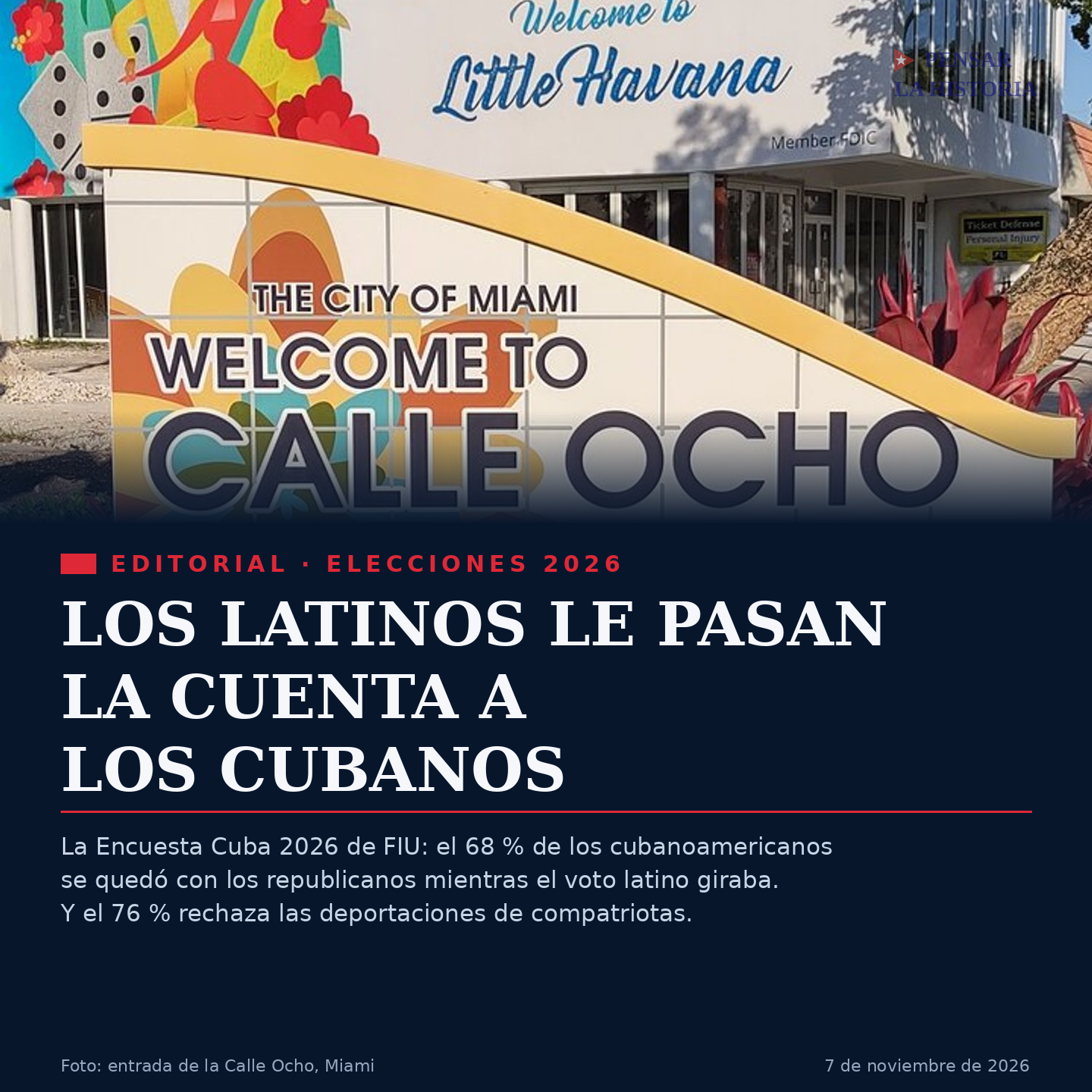
EDITORIAL | LOS LATINOS LE PASAN LA CUENTA A LOS CUBANOS
El día después de las elecciones de medio término empezó como un murmullo en las redes y hoy ya es tema de los noticieros: Telemundo 51 recogió este sábado el malestar de la mayoría de los latinos fuera de la Florida con los cubanos de Miami, a quienes reprochan haber sido la única comunidad que se mantuvo mayoritariamente con Donald Trump y el Partido Republicano mientras el voto latino, en general, lo castigaba. El influencer Carlos Eduardo Espina, una de las voces latinas con más alcance en Estados Unidos, lo resume en el título de su video más compartido: «No nos conoces». Y no es el único: los videos del reproche, como el del creador Diego Saul Reyna, publicado anoche, acumulan millones de interacciones, con comentarios que oscilan entre el argumento y el insulto.
EL ENOJO TIENE NÚMEROS
Nadie discute la base estadística del reproche. La Encuesta Cuba 2026 de la Universidad Internacional de Florida (FIU), aplicada a 1.004 cubanoamericanos del sur de la Florida entre el 4 y el 29 de septiembre, halló que el 68 % apoyaba a los candidatos republicanos al Congreso: exactamente el respaldo récord registrado en 2024. Enfrente, la encuesta de FIU y YouGov entre latinos en general mostró que el 54,6 % se inclinaba por los demócratas y que solo el 32,9 % aprueba a Trump; la de NBC News y Telemundo, que los latinos preferían el control demócrata del Congreso por 59 a 35; y Pew Research, que el 70 % de los latinos considera que las políticas de Trump han perjudicado a los hispanos. Como resumió el politólogo de FIU Eduardo Gamarra, el votante cubano «desde los años 80 ha sido sólidamente republicano». Hasta ahí, el reproche es un hecho.
PERO LA CUENTA ESTÁ MAL DIRIGIDA
La misma encuesta que confirma la fidelidad republicana documenta otra cosa que el reproche colectivo borra de un plumazo: el 76 % de los cubanoamericanos desaprueba las deportaciones de compatriotas sin antecedentes penales y el 87 % quiere que se reanude la tramitación de los beneficios migratorios. El registro electoral cubano es 53 % republicano, 27 % independiente y 18 % demócrata. Es decir, no hay un bloque: hay una mayoría ruidosa, una minoría que crece en silencio y una comunidad partida por la mitad entre su voto y su conciencia.
¿A quién debe pasársele la cuenta, entonces? A la maquinaria política de Miami que durante décadas vendió el voto cubano como incondicional y convirtió el dolor de Cuba en negocio electoral. Esa maquinaria prometió que la lealtad se pagaba con resultados, y el resultado está a la vista: desde 2025, ICE detiene a cubanos con formulario I-220A, la orden de libertad bajo supervisión con la que cientos de miles entraron al país, mientras los beneficiarios políticos de esa lealtad miran hacia otro lado. La propia congresista María Elvira Salazar tuvo que publicar en plena campaña un anuncio distanciándose de la política migratoria del presidente, reconociendo que los hispanos que lo ayudaron a llegar a la Casa Blanca «se sienten traicionados». Un apoyo que no se negocia no vale nada: esa es la lección que el voto cubano debería sacar de estas elecciones.
Y TAMBIÉN HAY QUE MIRARSE AL ESPEJO
Sería hipócrita pasarle la cuenta solo a la maquinaria. En una parte de la comunidad cubana, no en toda, pero sí en una parte ruidosa, corre desde hace años un rechazo, y a veces un desprecio abierto, hacia los demás latinos, sobre todo hacia los mexicanos y los centroamericanos: la idea de que «nosotros no somos inmigrantes como ellos», de que el cubano llegó por la vía legal y los demás no. Conviene decirlo sin rodeos: la ventaja cubana no fue un mérito personal, fue una ley: la Ley de Ajuste Cubano, que abre la residencia al año de llegar y que ningún mexicano ni ningún hondureño ha tenido jamás. Llegar con ese amparo no hace a nadie mejor que quien cruzó un desierto o un río jugándose la vida; hace, simplemente, al beneficiario de una política que otros no recibieron. Y ese desprecio se nota: se lee en los comentarios de cada video viral y se escucha en más de una sobremesa de Miami. Es, también, parte de lo que el resto de los latinos está cobrando hoy: nadie tiende puentes con quien lo mira por encima del hombro. Si la comunidad cubana quiere respeto en el debate latino, tiene que empezar por respetar.
Hay otro contraste que los demás latinos repiten en este debate, y duele porque tiene parte de verdad. El mexicano, el hondureño o el guatemalteco que llega a este país viene, por lo general, con una sola idea en la cabeza: trabajar, echar para adelante y ayudar a los que dejó atrás. Y no se le escucha renegar de su tierra: la extraña, la defiende y sueña con volver a ella. Una parte del cubano que llega, en cambio, se distingue por lo contrario: desde el primer día habla mal de su país de origen, como si denigrar a Cuba fuera el peaje de entrada a Estados Unidos. No hablamos de criticar a un gobierno, criticar es un derecho de cualquiera, sino de despreciar al país entero: su gente, su cultura, su historia. Esa actitud, que muchos latinos observan con asombro, también erosiona la simpatía hacia esta comunidad: quien reniega de su propia patria difícilmente convence a los demás de que respetará la ajena.
LA FACTURA ESTRATÉGICA
El precio ya se está cobrando donde más duele. Miami-Dade, el condado de la mayor comunidad cubana del país, votó por la candidata demócrata al Senado. Salazar está en recuento automático con una ventaja de apenas un millar de votos, y AP aún no declara ganador en el Distrito 26 de Díaz-Balart. Y si el rechazo latino se consolida, la factura mayor llega en 2028: Espina sostiene que Marco Rubio, al que los cubanoamericanos respaldan con el 58 % en la propia encuesta de FIU, no podría ganar el voto latino de estados como Texas o Nevada precisamente por ese rechazo hacia Miami. El secretario de Estado puede ser el orgullo de la comunidad y, a la vez, cargar con el techo que la imagen de esa comunidad le impone fuera de la Florida.
NI PERDÓN NI FAJAZÓN: PUENTES
La respuesta a este momento no es pedir perdón por votar ni devolver insulto por insulto. Cada video que enfrenta a un mexicano con un cubano es un regalo para quienes deportan a ambos sin preguntar el país de origen. La comunidad cubana tiene en su propia historia la mejor credencial para tender ese puente: sabe lo que es llegar con lo puesto y empezar de cero. Lo que no puede seguir haciendo es regalar su voto a cambio de promesas, ni permitir que una maquinaria hable en su nombre mientras la cuenta, la de verdad, la pagan los cubanos de a pie: los del I-220A, los de la Calle Ocho y los que hoy leen el reproche latino con una mezcla de vergüenza y rabia. Que la próxima cuenta la pague quien la debe: la política que usó a esta comunidad y la dejó sola cuando llegó la hora de cobrar.
Fuentes: Encuesta Cuba 2026 de la Florida International University (FIU), divulgada el 28-oct-2026; encuesta FIU/YouGov de votantes latinos; NBC News/Telemundo (vía CNN, 19-oct-2026); Pew Research Center; El País, 29-oct-2026; Le Monde, 9-oct-2026; segmento de Telemundo 51 recogido en redes el 7-nov-2026; resultados oficiales de Florida para Miami-Dade y los Distritos 26 y 27.
EDITORIAL | LATINOS ARE HANDING CUBANS THE BILL
The day after the midterm elections it began as a murmur on social media, and today it is already a news story: this Saturday, Telemundo 51 picked up the discontent of most Latinos outside Florida with Miami's Cubans, whom they reproach for being the only community that stayed mostly with Donald Trump and the Republican Party while the Latino vote, in general, punished him. Influencer Carlos Eduardo Espina, one of the Latino voices with the widest reach in the United States, sums it up in the title of his most shared video: "No nos conoces" (You Don't Know Us). And he is not the only one: the reproach videos, like the one by creator Diego Saul Reyna, posted last night, are accumulating millions of interactions, with comments that range from argument to insult.
THE ANGER HAS NUMBERS
Nobody disputes the statistical basis of the reproach. The Cuba Poll 2026 of Florida International University (FIU), conducted with 1,004 Cuban Americans in South Florida between September 4 and 29, found that 68% supported the Republican candidates for Congress: exactly the record backing registered in 2024. On the other side, the FIU and YouGov poll of Latinos in general showed that 54.6% leaned Democratic and that only 32.9% approve of Trump; the NBC News and Telemundo poll, that Latinos preferred Democratic control of Congress by 59 to 35; and Pew Research, that 70% of Latinos believe Trump's policies have harmed Hispanics. As FIU political scientist Eduardo Gamarra summarized it, the Cuban voter "has been solidly Republican since the 1980s." Up to that point, the reproach is a fact.
BUT THE BILL IS ADDRESSED TO THE WRONG PEOPLE
The same poll that confirms Republican loyalty documents something else that the collective reproach erases at a stroke: 76% of Cuban Americans disapprove of the deportations of compatriots with no criminal record, and 87% want the processing of immigration benefits resumed. Cuban voter registration is 53% Republican, 27% independent and 18% Democratic. In other words, there is no bloc: there is a loud majority, a minority growing in silence, and a community split in half between its vote and its conscience.
Who should be handed the bill, then? The Miami political machine that for decades sold the Cuban vote as unconditional and turned Cuba's pain into an electoral business. That machine promised that loyalty would be paid back with results, and the result is plain to see: since 2025, ICE has been detaining Cubans with the I-220A form, the order of release on supervision with which hundreds of thousands entered the country, while the political beneficiaries of that loyalty look the other way. Congresswoman María Elvira Salazar herself had to release an ad in the middle of the campaign distancing herself from the president's immigration policy, acknowledging that the Hispanics who helped him reach the White House "feel betrayed." Support that is never negotiated is worth nothing: that is the lesson the Cuban vote should draw from these elections.
AND WE MUST ALSO LOOK IN THE MIRROR
It would be hypocritical to hand the bill only to the machine. In one part of the Cuban community, not all of it, but a loud part, there has run for years a rejection, and at times an open contempt, toward other Latinos, above all toward Mexicans and Central Americans: the idea that "we are not immigrants like them," that the Cuban arrived by the legal route and the others did not. It should be said plainly: the Cuban advantage was not a personal merit, it was a law: the Cuban Adjustment Act, which opens residency after one year in the country and which no Mexican and no Honduran has ever had. Arriving under that protection makes nobody better than someone who crossed a desert or a river risking their life; it makes them, simply, the beneficiary of a policy that others never received. And that contempt shows: it can be read in the comments of every viral video and heard at more than one Miami dinner table. It is also part of what the rest of Latinos are now charging for: nobody builds bridges with someone who looks down on them. If the Cuban community wants respect in the Latino debate, it has to start by showing respect.
There is another contrast that other Latinos repeat in this debate, and it hurts because part of it is true. The Mexican, the Honduran or the Guatemalan who arrives in this country comes, in general, with a single idea in mind: to work, to get ahead and to help those left behind. And you do not hear them renounce their homeland: they miss it, they defend it and they dream of returning to it. A part of the arriving Cuban, by contrast, stands out for the opposite: from day one they speak ill of their country of origin, as if denigrating Cuba were the toll for entering the United States. We are not talking about criticizing a government, criticizing is anyone's right, but about despising the entire country: its people, its culture, its history. That attitude, which many Latinos watch with astonishment, also erodes sympathy toward this community: whoever renounces their own homeland will hardly convince others that they will respect someone else's.
THE STRATEGIC BILL
The price is already being charged where it hurts most. Miami-Dade, the county with the largest Cuban community in the country, voted for the Democratic candidate for the Senate. Salazar is in an automatic recount with a lead of barely a thousand votes, and AP has not yet declared a winner in Díaz-Balart's District 26. And if Latino rejection consolidates, the bigger bill arrives in 2028: Espina argues that Marco Rubio, whom Cuban Americans back with 58% in FIU's own poll, could not win the Latino vote of states like Texas or Nevada precisely because of that rejection of Miami. The secretary of state may be the pride of the community and, at the same time, carry the ceiling that the image of that community imposes on him outside Florida.
NEITHER APOLOGIES NOR FIGHTS: BRIDGES
The answer to this moment is not to apologize for voting, nor to return insult for insult. Every video that sets a Mexican against a Cuban is a gift to those who deport both without asking their country of origin. The Cuban community has in its own history the best credential to build that bridge: it knows what it is to arrive with only the clothes on its back and start from zero. What it cannot keep doing is giving away its vote in exchange for promises, nor allow a machine to speak in its name while the bill, the real one, is paid by ordinary Cubans: those with the I-220A, those of Calle Ocho and those who today read the Latino reproach with a mix of shame and rage. Let the next bill be paid by whoever owes it: the politics that used this community and left it alone when the time came to collect.
Sources: Cuba Poll 2026 of Florida International University (FIU), released Oct. 28, 2026; FIU/YouGov poll of Latino voters; NBC News/Telemundo (via CNN, Oct. 19, 2026); Pew Research Center; El País, Oct. 29, 2026; Le Monde, Oct. 9, 2026; Telemundo 51 segment picked up on social media on Nov. 7, 2026; official Florida results for Miami-Dade and Districts 26 and 27.
Ver en Facebook ↗See on Facebook ↗