Camilo Cienfuegos: la verdad contra 67 años de versionesCamilo Cienfuegos: The Truth Against 67 Years of Versions
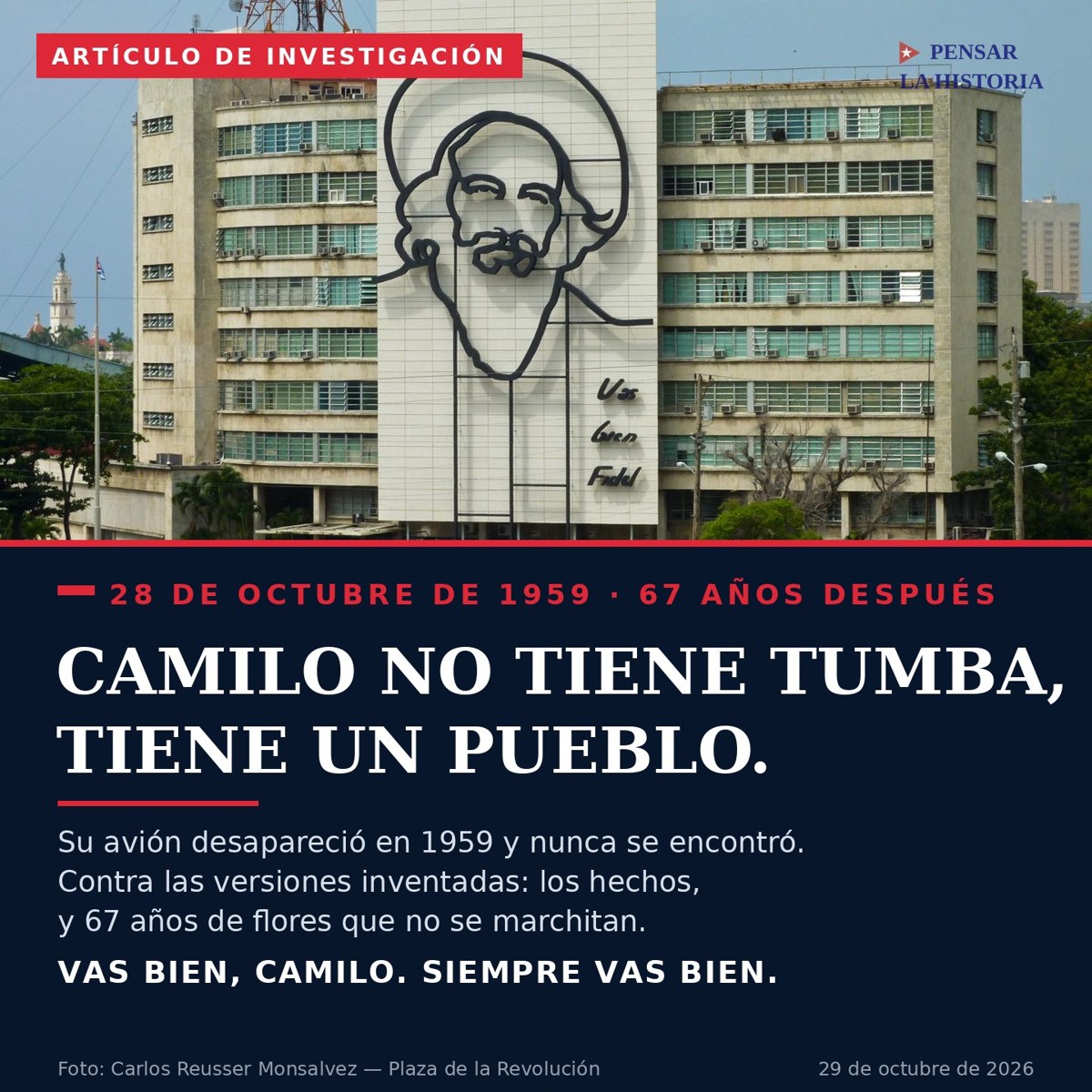
🌺 CAMILO CIENFUEGOS: LA VERDAD CONTRA 67 AÑOS DE VERSIONES.
Ayer se cumplieron 67 años de la desaparición del comandante Camilo Cienfuegos, y como cada año volvieron a circular las mismas versiones sobre su muerte. Algunas nacieron de la confusión; otras, de la mala intención. Vale la pena contar la historia completa.
1️⃣ LOS HECHOS — 28 DE OCTUBRE DE 1959
Camilo, jefe del Estado Mayor del Ejército Rebelde, había viajado a Camagüey para resolver la sedición de Huber Matos. Cumplida la misión, despegó de regreso a La Habana a las 6:01 PM en el Cessna 310 FAR-53, con el piloto teniente Luciano Fariñas —un aviador experimentado, con unas 2 000 horas de vuelo— y su escolta Félix Rodríguez. El vuelo duraba unas dos horas y llevaba combustible para tres. Otros pilotos reportaron una tormenta que habría obligado a desviarse hacia el norte. Nunca hubo llamada de auxilio. Nunca llegó.
2️⃣ LA BÚSQUEDA — UN PAÍS ENTERO BUSCANDO A CAMILO
Durante 15 días se peinó la costa norte, de Ciego de Ávila a Matanzas: Punta Alegre, los cayos, el canal viejo de Bahamas. Participaron 70 aviones militares y civiles, embarcaciones pesqueras y pobladores de todo el país; hasta aviones de la Fuerza Aérea de Estados Unidos colaboraron. Fidel dirigió personalmente la búsqueda y sobrevoló la zona muchas veces como copiloto. En medio de aquellos días circuló una noticia falsa —que Camilo había aparecido— y la alegría popular estalló para convertirse en llanto cuando se desmintió. El 12 de noviembre, Fidel compareció en televisión, contó la búsqueda hora por hora y confirmó la pérdida definitiva con una frase que se volvió epitafio: «Camilo salió del pueblo y en el pueblo hay muchos Camilos».
3️⃣ LAS VERSIONES — DE DÓNDE SALIERON Y CUÁNDO
Sin restos y sin avión, el vacío lo llenó la especulación, sobre todo desde el exilio. Son cuatro las versiones que llevan 67 años repitiéndose:
📌 «Fidel lo mandó a matar». Es la tesis política más difundida, y se apoya en tres supuestos motivos: que la popularidad de Camilo rivalizaba con la de Fidel; que era amigo de Huber Matos y no estaba convencido de las acusaciones en su contra; y que habría frenado el rumbo que tomaba la Revolución. ¿Quiénes la sostienen? El propio Huber Matos, que tras cumplir 20 años de prisión la repitió en el exilio y en sus memorias; Juan Orta Córdoba, exsecretario de Fidel, que la atribuyó a una orden directa suya; y Carlos Franqui, que apuntó a otro ejecutor: el oficial de inteligencia Osvaldo Sánchez, encargado de la seguridad de Camilo. José Pardo Llada, que acompañó a Fidel durante la búsqueda, dejó una frase ambigua que el exilio cita mucho: que Fidel «quizás no lo mató, pero ciertamente no sintió su muerte». El problema de esta tesis no es quién la dice: es que en 67 años nadie ha presentado un solo documento, una sola grabación, un solo testigo directo que la sostenga. Y choca con un hecho: Camilo acababa de cumplir la orden de arrestar a Matos y de defenderla en público.
📌 El derribo por un Sea Fury. La versión con más apariencia «técnica»: un caza Sea Fury pilotado por Blas Domínguez, piloto personal de Fidel, habría despegado de Camagüey a las 18:11 —diez minutos después del Cessna—, ametrallado el avión sobre el mar y regresado 45 minutos después sin la cubierta de lona que protege el cañón de 20 mm. Todo eso, se asegura, quedó grabado en la cinta de la torre de control. Pero esa cinta jamás ha sido mostrada por nadie, y sin ella la versión es solo un relato con detalles: preciso en las horas, vacío en las pruebas. Una variante hermana dice que un piloto de las FAR lo derribó por error, confundiéndolo con un avión hostil — tampoco probada jamás.
📌 «Lo mató Raúl, por celos». La otra gran versión familiar: en el campamento de Columbia, Raúl le habría reclamado a Camilo no haberle traído a Matos para juzgarlo; en la discusión ambos habrían sacado las armas y un tercero disparó. Es una escena de película que circuló durante décadas entre cubanos de la época y en el exilio, sin un solo testimonio de alguien que estuviera allí. La ironía final la puso la historia: fue bajo el gobierno de Raúl Castro, en 2009, cuando la imagen gigante de Camilo se colocó en la fachada de la Plaza de la Revolución, junto a la del Che.
📌 «No murió: huyó o está preso». La más temprana y la más folclórica. Ya en 1960, una exenfermera habanera llegada a Miami aseguró haber atendido a Camilo herido (las autoridades la declararon mentalmente inestable). En 1961 y 1962, una mujer llamada Vani Lake Maris ocupó titulares en la prensa de Estados Unidos con relatos que cambiaban con el tiempo —y que se endurecían contra Fidel al ritmo de la Guerra Fría y de Playa Girón—. Otros lo «ubicaron» viviendo en Ybor City, Tampa, y otra variante lo tuvo preso en secreto hasta salir de Cuba junto a Huber Matos en 1979. Ninguna de esas «apariciones» resistió la más mínima comprobación.
El patrón se repite en las cuatro: nacen lejos de Cuba, crecen sin pruebas y se alimentan del mismo vacío —un avión que el mar se tragó sin dejar rastro—. Que nadie se confunda: discutirlas no es un problema; el problema es presentarlas como hechos cuando son, hasta hoy, literatura de la Guerra Fría.
4️⃣ LO QUE DICE LA EVIDENCIA
El Che, su hermano de lucha —que lo llamó Señor de la Vanguardia y le puso Camilo a su propio hijo—, descartó siempre cualquier crimen. El embajador de Estados Unidos, Philip Bonsal, tampoco lo creyó posible: «Cienfuegos no era una amenaza para nadie». Y está el hecho más elocuente: el 26 de octubre, dos días antes de desaparecer, Camilo habló frente al Palacio Presidencial en defensa de la Revolución y de la detención de Matos. El consenso de los historiadores es claro: lo más probable es un accidente —vuelo nocturno, tormenta, desvío y mar abierto.
5️⃣ EL HOMENAJE QUE NO CESA
La primera gran jornada de la flor fue el 28 de octubre de 1960, a un año de la desaparición: la impulsó Celia Sánchez Manduley, junto a compañeros del Ejército Rebelde y las organizaciones juveniles, y miles de niños, jóvenes y trabajadores marcharon a las costas, los malecones, los ríos y los muelles de todo el país para lanzar claveles, rosas y flores silvestres al agua bajo la consigna «Una flor para Camilo». El Che —que lo llamó Señor de la Vanguardia— fue el gran promotor de convertir ese gesto en jornada nacional permanente: el 28 de octubre de 1964, a cinco años de la desaparición, pronunció un discurso memorable desde Pinar del Río en el que vinculó la flor con el compromiso diario del pueblo. Desde entonces, generaciones de niños cubanos cantan «Una flor para Camilo, al agua vamos a echar, todos los niños de Cuba lo queremos recordar» y lanzan sus flores al mar, a los ríos, a cualquier agua que corra hacia el mar. Ayer mismo, en Ciego de Ávila —la tierra donde se le buscó—, desfilaron pioneros, estudiantes, trabajadores… y también gente que no milita en nada, pero que cada año aparece con su flor porque siente que ese gesto le pertenece.
Camilo no tiene tumba. Tiene algo más grande: un pueblo que 67 años después se niega a olvidarlo, y una verdad que ninguna versión inventada ha podido manchar.
Vas bien, Camilo. Siempre vas bien. 🌺
#CamiloCienfuegos #UnaFlorParaCamilo #Cuba #HistoriaDeCuba
🌺 CAMILO CIENFUEGOS: THE TRUTH AGAINST 67 YEARS OF VERSIONS.
Yesterday marked 67 years since the disappearance of Commander Camilo Cienfuegos, and as every year, the same versions about his death began to circulate again. Some were born of confusion; others, of ill intent. It is worth telling the whole story.
1️⃣ THE FACTS — OCTOBER 28, 1959
Camilo, chief of staff of the Rebel Army, had traveled to Camagüey to put down the sedition of Huber Matos. With the mission accomplished, he took off back to Havana at 6:01 PM in the Cessna 310 FAR-53, with the pilot, Lieutenant Luciano Fariñas — an experienced aviator, with some 2,000 flight hours — and his escort, Félix Rodríguez. The flight lasted about two hours and it carried fuel for three. Other pilots reported a storm that would have forced him to deviate toward the north. There was never a distress call. He never arrived.
2️⃣ THE SEARCH — AN ENTIRE COUNTRY LOOKING FOR CAMILO
For 15 days the north coast was combed, from Ciego de Ávila to Matanzas: Punta Alegre, the cays, the Old Bahama Channel. Seventy military and civilian aircraft took part, fishing boats, and residents from all over the country; even United States Air Force planes collaborated. Fidel personally directed the search and flew over the zone many times as copilot. In the middle of those days, a false report circulated — that Camilo had turned up — and popular joy erupted, only to turn into tears when it was denied. On November 12, Fidel appeared on television, recounted the search hour by hour, and confirmed the definitive loss with a phrase that became an epitaph: "Camilo came from the people, and in the people there are many Camilos."
3️⃣ THE VERSIONS — WHERE THEY CAME FROM AND WHEN
Without remains and without an airplane, the void was filled by speculation, above all from exile. There are four versions that have been repeated for 67 years:
📌 "Fidel ordered him killed." It is the most widespread political thesis, and it rests on three supposed motives: that Camilo's popularity rivaled Fidel's; that he was a friend of Huber Matos and was not convinced of the accusations against him; and that he would have put the brakes on the course the Revolution was taking. Who sustains it? Huber Matos himself, who after serving 20 years in prison repeated it in exile and in his memoirs; Juan Orta Córdoba, a former secretary of Fidel's, who attributed it to a direct order from him; and Carlos Franqui, who pointed to another executor: intelligence officer Osvaldo Sánchez, in charge of Camilo's security. José Pardo Llada, who accompanied Fidel during the search, left behind an ambiguous phrase that exile quotes often: that Fidel "perhaps did not kill him, but certainly did not feel his death." The problem with this thesis is not who says it: it is that in 67 years no one has presented a single document, a single recording, a single direct witness to sustain it. And it collides with a fact: Camilo had just carried out the order to arrest Matos and to defend it in public.
📌 The shoot-down by a Sea Fury. The version with the most "technical" appearance: a Sea Fury fighter piloted by Blas Domínguez, Fidel's personal pilot, supposedly took off from Camagüey at 6:11 PM — ten minutes after the Cessna — machine-gunned the plane over the sea, and returned 45 minutes later without the canvas cover that protects the 20 mm cannon. All of that, it is claimed, was recorded on the control tower tape. But that tape has never been shown by anyone, and without it the version is only a story with details: precise in the times, empty in the evidence. A sister variant says that an FAR pilot shot him down by mistake, mistaking him for a hostile aircraft — never proven, either.
📌 "Raúl killed him, out of jealousy." The other great family version: at Camp Columbia, Raúl supposedly reproached Camilo for not having brought him Matos to put him on trial; in the argument both supposedly drew their weapons and a third man fired. It is a movie scene that circulated for decades among Cubans of the time and in exile, without a single testimony from someone who was there. History provided the final irony: it was under the government of Raúl Castro, in 2009, that the giant image of Camilo was placed on the facade of the Plaza de la Revolución, next to Che's.
📌 "He did not die: he fled or he is in prison." The earliest and the most folkloric. As early as 1960, a former Havana nurse who had arrived in Miami claimed to have treated a wounded Camilo (the authorities declared her mentally unstable). In 1961 and 1962, a woman named Vani Lake Maris made headlines in the United States press with accounts that changed over time — and that hardened against Fidel at the pace of the Cold War and of Playa Girón. Others "placed" him living in Ybor City, Tampa, and another variant had him secretly in prison until he left Cuba together with Huber Matos in 1979. None of those "appearances" withstood the slightest scrutiny.
The pattern repeats in all four: they are born far from Cuba, they grow without evidence, and they feed on the same void — an airplane that the sea swallowed without leaving a trace. Make no mistake: discussing them is not the problem; the problem is presenting them as facts when they are, to this day, Cold War literature.
4️⃣ WHAT THE EVIDENCE SAYS
Che, his brother in struggle — who called him Lord of the Vanguard and named his own son Camilo — always dismissed any crime. The ambassador of the United States, Philip Bonsal, did not believe it possible either: "Cienfuegos was a threat to no one." And there is the most eloquent fact: on October 26, two days before he disappeared, Camilo spoke in front of the Presidential Palace in defense of the Revolution and of the detention of Matos. The consensus of historians is clear: the most likely thing is an accident — night flight, storm, deviation, and open sea.
5️⃣ THE TRIBUTE THAT NEVER CEASES
The first great day of the flower was October 28, 1960, one year after the disappearance: it was promoted by Celia Sánchez Manduley, together with comrades of the Rebel Army and the youth organizations, and thousands of children, young people, and workers marched to the shores, the seawalls, the rivers, and the docks of the entire country to toss carnations, roses, and wildflowers into the water under the slogan "A Flower for Camilo." Che — who called him Lord of the Vanguard — was the great promoter of turning that gesture into a permanent national day: on October 28, 1964, five years after the disappearance, he delivered a memorable speech from Pinar del Río in which he linked the flower to the daily commitment of the people. Since then, generations of Cuban children sing "A flower for Camilo, into the water we shall cast it, all the children of Cuba want to remember him" and toss their flowers into the sea, into the rivers, into any water that runs toward the sea. Just yesterday, in Ciego de Ávila — the land where he was searched for — pioneers, students, and workers marched... and also people who are militants of nothing, but who every year show up with their flower because they feel that gesture belongs to them.
Camilo has no tomb. He has something greater: a people that 67 years later refuses to forget him, and a truth that no invented version has been able to stain.
You are doing well, Camilo. You are always doing well. 🌺
#CamiloCienfuegos #UnaFlorParaCamilo #Cuba #HistoriaDeCuba
Ver en Facebook ↗See on Facebook ↗