Parques solares: ¿pueden estabilizar el SEN?Solar Parks: Can They Stabilize the National Grid?
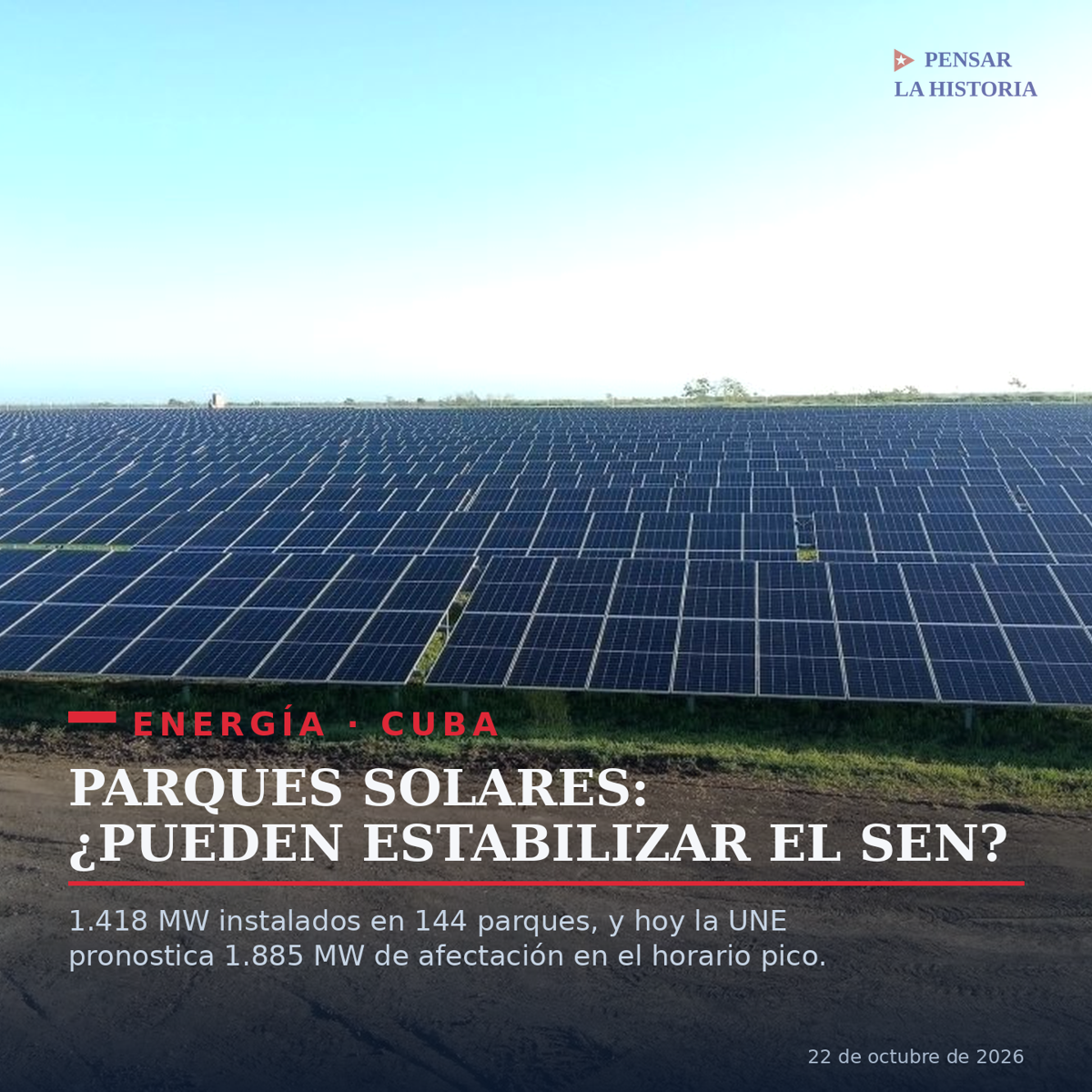
☀️⚡ PARQUES SOLARES: ¿PUEDEN ESTABILIZAR EL SEN?
Cuba vive una paradoja eléctrica: nunca tuvo tanta energía solar… y nunca tuvo apagones tan grandes. Hasta septiembre se habían instalado 1.418 MW en 144 parques fotovoltaicos y, aun así, para hoy la UNE pronostica una afectación de 1.885 MW en el horario pico. ¿Cuál es entonces la estrategia para salir de la crisis?
📌 LA ESTRATEGIA.
La apuesta oficial es «salir de la crisis con recursos propios»: dejar de depender del combustible importado combinando cinco frentes — recuperar las termoeléctricas con mantenimientos, explotar al máximo el crudo y el gas nacionales, desplegar fuentes renovables con almacenamiento, y sumar a municipios, empresas y ciudadanos que generen su propia energía (ya hay exenciones aduaneras para importar sistemas solares).
La transición está concebida en tres etapas: 24 % de generación renovable en 2030 —estudios de la UNE y las universidades elevan la meta hasta 37 %—, 40 % en 2035, dejando de importar combustibles, y una matriz 100 % limpia en 2050, alimentada por el sol, el viento y los residuos vegetales y animales.
🔆 LAS RENOVABLES, POR HORIZONTES
▪️ Corto plazo (2026-2028): completar el programa solar —92 parques y unos 2.000 MW hacia 2028—, contratar 100 MW de sistemas de acumulación para estabilizar la red, terminar el parque eólico Herradura 1 en Las Tunas (33 MW, detenido por impagos y hoy con financiamiento gestionado) y llevar la participación renovable a alrededor del 15 % al cierre de 2026.
▪️ Mediano plazo (2030-2035): cumplir el 24 % de 2030, recortar más de un millón de toneladas de combustible importado y saltar al 40 % en 2035. Para entonces, la biomasa y la eólica deberían pesar mucho más que hoy.
▪️ Largo plazo (2050): el 100 % renovable. Es la meta declarada de «soberanía energética»: ni una gota de combustible importado para generar electricidad.
🌿 ¿Y LAS OTRAS RENOVABLES?
La solar no es la única, ni siquiera la mayor… todavía. Según IRENA, a finales de 2024 Cuba tenía 440 MW de bioenergía —sobre todo cogeneración con bagazo en los centrales azucareros—, 292 MW fotovoltaicos, 69 MW hidráulicos y apenas 16 MW eólicos.
La biomasa es la renovable «firme» del país: genera también de noche. Su símbolo es la bioeléctrica del Ciro Redondo (60 MW, más de 180 millones de dólares, quema bagazo en zafra y marabú el resto del año), pero llegó a paralizarse por falta de bagazo: su futuro depende de que se recupere la producción de caña y azúcar.
La eólica es la gran deuda: el potencial medido supera los 1.100 MW en 21 zonas del país, pero lo instalado es mínimo —Gibara suma 9,6 MW envejecidos— y los proyectos grandes (Herradura 2, de 50 MW, y Herradura 3, de unos 30 MW) siguen en papel o en medición de vientos.
La hidráulica aporta estabilidad más que volumen: unas 170 unidades en todo el país, con el Hanabanilla (43 MW) como única central de peso, útil incluso para regular la frecuencia del sistema. El biogás agropecuario y el bombeo solar de agua avanzan como complemento local.
⚠️ LA LETRA PEQUEÑA
El plan choca con tres realidades: el almacenamiento es testimonial (una sola batería confirmada de 50 MW, y el propio MINEM admite que no está diseñada para después del ocaso), más de 1.000 MW de grupos electrógenos están parados por falta de combustible, y recapitalizar el sistema costaría entre 8.000 y 10.000 millones de dólares que hoy no están. Resumiendo, la solar es buena inversión «siempre que se haga con inteligencia» —y sin respaldo, no da carga base.
La dirección es la correcta y el despliegue solar es real. La pregunta del titular se responde así: los parques solares son una pieza imprescindible de la salida, pero estabilizar el SEN depende de lo que aún falta — baterías, biomasa firme, combustible y financiamiento.
📷 Foto: parque solar fotovoltaico en Vertientes, Camagüey (Cubadebate).
Fuentes: UNE · MINEM · IRENA · pv magazine · EFE · Bloomberg · CNN.
☀️⚡ SOLAR PARKS: CAN THEY STABILIZE THE SEN?
Cuba is living an electrical paradox: it has never had so much solar energy… and it has never had such huge blackouts. Through September, 1,418 MW had been installed in 144 photovoltaic parks and, even so, for today the UNE forecasts an impact of 1,885 MW at peak hours. What, then, is the strategy for getting out of the crisis?
📌 THE STRATEGY.
The official bet is to "get out of the crisis with our own resources": to stop depending on imported fuel by combining five fronts — recovering the thermoelectric plants through maintenance, making the most of national crude oil and gas, deploying renewable sources with storage, and adding municipalities, companies and citizens who generate their own energy (there are already customs exemptions for importing solar systems).
The transition is designed in three stages: 24% renewable generation in 2030 —studies by the UNE and the universities raise the goal to as much as 37%—, 40% in 2035, ceasing to import fuels, and a 100% clean matrix in 2050, fed by the sun, the wind, and plant and animal waste.
🔆 RENEWABLES, BY HORIZONS
▪️ Short term (2026-2028): complete the solar program —92 parks and some 2,000 MW by 2028—, contract 100 MW of storage systems to stabilize the grid, finish the Herradura 1 wind farm in Las Tunas (33 MW, halted over non-payments and today with financing being arranged) and bring the renewable share to around 15% by the close of 2026.
▪️ Medium term (2030-2035): meet the 24% of 2030, cut more than a million tons of imported fuel and jump to 40% in 2035. By then, biomass and wind power should weigh much more than they do today.
▪️ Long term (2050): 100% renewable. It is the declared goal of "energy sovereignty": not a single drop of imported fuel to generate electricity.
🌿 AND THE OTHER RENEWABLES?
Solar is not the only one, not even the largest… yet. According to IRENA, at the end of 2024 Cuba had 440 MW of bioenergy —above all cogeneration with bagasse at the sugar mills—, 292 MW photovoltaic, 69 MW hydroelectric and barely 16 MW wind.
Biomass is the country's "firm" renewable: it also generates at night. Its symbol is the Ciro Redondo bioelectric plant (60 MW, more than 180 million dollars, burns bagasse during the harvest and marabou the rest of the year), but it came to a standstill for lack of bagasse: its future depends on sugarcane and sugar production recovering.
Wind power is the great debt: the measured potential exceeds 1,100 MW in 21 zones of the country, but what is installed is minimal —Gibara totals 9.6 MW of aging capacity— and the big projects (Herradura 2, of 50 MW, and Herradura 3, of some 30 MW) are still on paper or in wind measurement.
Hydroelectric power provides stability more than volume: some 170 units across the country, with Hanabanilla (43 MW) as the only plant of weight, useful even for regulating the system's frequency. Agricultural biogas and solar water pumping are advancing as a local complement.
⚠️ THE FINE PRINT
The plan runs up against three realities: storage is token (a single confirmed battery of 50 MW, and the MINEM itself admits it is not designed for after dusk), more than 1,000 MW of generator sets are stopped for lack of fuel, and recapitalizing the system would cost between 8,000 and 10,000 million dollars that are not there today. In short, solar is a good investment "as long as it is done intelligently" —and without backup, it provides no base load.
The direction is the right one and the solar deployment is real. The headline question is answered like this: solar parks are an indispensable piece of the way out, but stabilizing the SEN depends on what is still missing — batteries, firm biomass, fuel and financing.
📷 Photo: photovoltaic solar park in Vertientes, Camagüey (Cubadebate).
Sources: UNE · MINEM · IRENA · pv magazine · EFE · Bloomberg · CNN.
Ver en Facebook ↗See on Facebook ↗